
By Piotr Sacha (Illustrations) with text by Wojciech Grajkowski
Reading guide age 10 years and over (would be enjoyed by both younger children being read to, and adults, however)
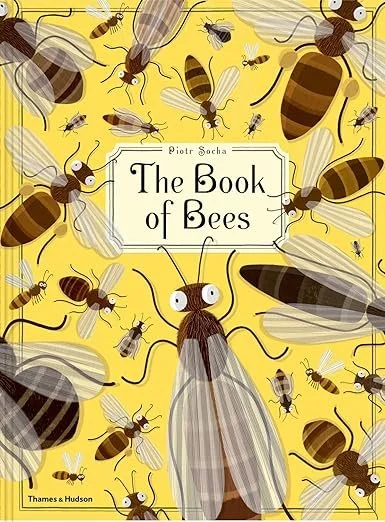
I had very high hopes for this book. It is large, eye-catching and full of really wonderful illustrations. Did it live up to my hopes? Well, it’s complicated…..
There is no doubt at all that this is a very engaging book. Both the text and illustrations have been approached with a good dose of humour, whilst covering all manner of topics from bees and dinosaurs, through to their plight in today’s modern world. In between both of those things, we find out about beekeeping through the ages, how bees make honey, how and why honeybees dance, their importance as pollinators and what might happen if they disappear (robot bees anyone?).
We learn about their place in ancient Egypt and Greece, when they first met man and our relationship through the ages, through to how we draw on certain aspects in nature to influence our buildings, our inventions and our medicine. On top of all that, if you want to find out who allowed themselves to get stung by 2,443 bees, and why, then this is the book for you.
The complicated bit? This beautiful, fun book is a book of honeybees, not a book about bees in general. There are many thousands of native bee species across the world that are as important, if not more so, than the honeybee in terms of the health of our planet, and which are arguably more under threat. Honeybees are not the ‘bee’ all and end all of bees, and much more awareness is needed of the importance of native bee species, and what we will lose if we lose those.
This book mentions that there are other bees in a ‘blink and you’ll miss it’ kind of way. It would be very easy to read and think that honeybees are the only bees of importance.
However, am I expecting too much of a children’s book?
Part of me thinks that I am. The other part of me wishes that this book covered a bit more than it does to give a fuller picture. It will leave its readers (both children and adult) more curious about bees, which is a good thing. It would have been nice though if it had been clearer that there are many more types of bees to be curious about, many of which look nothing like the honeybee, and which live their lives very differently to the honeybee.
Maybe this book will serve as a gateway book, leading readers to explore more, and to discover those other bees.
Would I recommend it? For the illustrations alone it is worth looking at. It is informative and fun. It should, however, be read with the caveat that it isn’t the whole story…..